
Self Service Checkouts

Most people who know me would probably agree that I’m a bit of an antisocial bastard. This, no doubt, is one of the reasons that I like self service checkouts in supermarkets. At least, I like the idea. It should minimise the contact I need to have with real people. It’s similar to internet banking in that respect. No human contact – marvellous.

In practice however, the bloody things are really annoying. It starts off when I bring my own bag. I’m still rubbish at remembering to do that, but I’m getting better. It’s amazing the incentive that 5p can have. So the checkout asks me to put my bags on the scale and click “done”. At that point, it decides not to trust me and I have to wait for a human to check that all I’ve put on the scales is bags. Humph! Last time that happened, I picked up my bags and went to a conventional checkout. If I have to interact with humans, it might as well be efficient, rather than waiting for the girl being chatted up by the shelf-stacker to notice the large flashing red light above my checkout.

So, having got past the bag crisis, I begin to scan my groceries. At this point the checkout starts braying at me in a loud, strident voice to “Please put the item into the bagging area”. Either I’m really slow at this, or the timing is all wrong. Give me a chance before you start to nag me. Please.

Next comes the booze. All right, I accept that some form of age checking is needed when buying alcohol, but does it have to be so judgemental?  When the girl can next be dragged away from her compelling chat about the X-Factor, she wanders over and without even glancing at me, declares me to be “clearly over 25”. OK, I’m well past mark of mouth, but she could make a pretence of checking. Is it my clothes that have given me away? The grey hair? The middle-aged paunch?

Then there’s the troublesome item. Presumably it weighs just a bit less or a bit more that it is supposed to. The margin for tolerance on some items must be wafer thin. These machines are not in “benefit of the doubt” mode. Over comes the girl again, to confirm that an apple is indeed an apple.

Where’s the trust in all this? Perhaps the problem is that I’ve not identified myself at this point. I do that at time of payment by scanning the loyalty card. Why not do that at the start of the whole process and then build up a bit of a history with the customer – he shops here all the time and can be trusted. This after all, is part of what loyalty cards are for, though admittedly, they are mostly so the shop can record that I buy a lot of wine, so they can target me with offers for detergent.

Finally, it’s time to pay. But, I have a voucher that says 60p off if I buy some bacon. I’m always buying  bacon, so this makes sense. I scan the voucher. Now the girl must be summoned once again to confirm that the voucher is valid. If only computers could do this sort of thing.

Supermarkets are just starting to catch up with the rest of the retailers and offering contactless payments for smaller amounts. However, at least one chain has done this incredibly badly. The checkout asks me how I would like to pay. I click on “credit/debit card” and I’m instructed to insert my card into the card reader. Sadly, I know a bit about these things and I can clearly see that the device is capable of taking a contactless payment, so I waft my card at it. It detects my card, declines the payment, and informs me that if I’d wanted to make a contactless payment, I should have selected that option as my payment type. Really? How shit is that?

Finally, I’m about to leave, when it emerges that the ludicrously overpriced safety blades for my razor have a security tag attached. Another wait for the teenager, who then can’t work out how the instrument of torture used to remove security tags works. She calls a colleague and ten minutes later, I’m free to go, with my now slightly mangled box of razor blades.

One of the larger supermarkets in our area has taken this a step further, allowing you to take a scanner with you to scan your your shopping as you go. I first tried this years ago in a Safeway, before they all became Morrisons. I quite liked the approach, but it didn’t catch on. I’ve seen it in Watitrose, but I don’t shop there often enough to make it worthwhile registering. However, when I saw this scheme introduced into a local Tesco, I though “Yeah. Why not?” All went well until I came to pay. Once again, I am confronted with a self-service checkout, but this time I scan the scanner and my bill appears. So far so good. But, then I am selected for a “random security check”. Marvellous. This involves some woman, who looks like one of the dinner ladies at my old junior school, rummaging through my shopping and scanning a few items to check that I had, indeed, scanned these myself. What was weird was that she did not select the new £300 Dyson that was in the trolley, nor even the bottle of gin. No – the items I was deemed most likely to have sneaked into my trolley were a tube of toothpaste and some sun-dried tomatoes. Relieved that I have escaped the full cavity search, I am finally allowed to pay and leave.

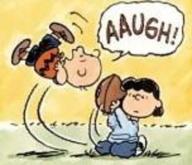
The bizarre thing about all this is that I charlie_brown_lucy_footballcontinue to use these self-service checkouts, convinced that this time, it’ll all go right.  I’m like Charlie Brown with that football.
 

Fast Bowling

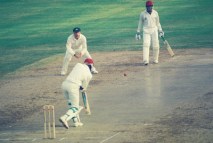
With the retirement if Mitchell Johnson, the game of cricket has lost another one of its truly fast bowlers.

You can wax lyrical all you like about the metronomic precision of McGrath, the craft of Anderson, the guile of Warne, or the shear weirdness of Murali. But, for true drama and excitement, you need a fast bowler on a decent pitch tearing in off his long run with the full umbrella cordon and the courageous batsman doing everything he can to survive, both literally and figuratively. Think Holding against Boycott; Donald against Atherton. Hostile, brutal, breath-taking stuff.

He bowls to the left.
He bowls to the right.
That Mitchell Johnson,
His bowling is shite!

Johnson was perhaps more mercurial than most of the greats of the game. I saw him at Cardiff in the first Ashes test of 2009. He took a few wickets, but he was all over the place and failed to break the final wicket stand between Panesar and Anderson. The crowd cheerfully chanted the Mitchell Johnson song to the tune of that Stealer’s Wheel number. Four years later, though he was devastating. He had found a way to make that seemingly fragile, slingy action repeatable and was, for a while, the best bowler in the world.

I’ve been lucky enough to see quite a few of the great fast bowlers in action, but I do worry about them being eliminated from the game. There are several reasons for this.

  • There is less of an obvious role for an out-and-out quick in coloured clothing cricket. They cannot be guaranteed to be economical. The really thrilling attacking fields have no place in a game where runs, not wickets matter. Stupid, batsman-favouring rules prevent the use of proper short balls as a weapon.
  • Modern pitches are becoming dull and lifeless. Reme101303_78a2ad6c9cf985841ce43d86d6af5361mber Sabina Park in the 80s. You could see your reflection on it. Pitches in the West Indies are now more like a long jumper’s sandpit. No wonder they don’t produce great bowlers any more. Who would want to bowl quickly on a beach?
  • India is having a huge influence on the game of cricket. They are the economic powerhouse of the modern game and they care only for batsmen. Who are the great heroes of India? Sachin, Laxman, Dravid, Dhoni, Gavaskar. Kumble and Bedi might get a look in if not for the obsession with the short form of the game but a pace bowler… Kapil? Great player, but hardly a hell-raiser.
  • Domestic cricket no longer attracts the pace bowler as it once did. And, when a great player does come to play county cricket, it’s no longer even for a whole season. Players used to be associated with Counties in England for much of their career. Wasim at Lancashire, Marshall at Hampshire, Walsh at Gloucestershire, Donald at Warwickshire. Fans took these players to their hearts and County cricket mattered, because you were watching world class performers. The reduction in overseas pros to just one per county put a greater emphasis on batsmen and all-rounders – they were more use in the lucrative one day games.

Enlarging on this last point for a while, by way of self-indulgence, the fastest bowling I have ever seen in the flesh was by a young Allan Donald. As a student in Birmingham, I saw a lot of Warwickshire in the late 80s. South Africa was still in the wilderness and we fondly hoped that England would be able to persuade Donald to play for them. No such luck. I have misty memories of sitting side-on at Edgbaston for one of Donald’s spells. I think it was against Lancashire. Little Keith Piper was standing miles back, with the slips even deeper. It’s the quickest spell I’ve ever seen and I did see Shoaib in his pomp and he was not slow.

On the international scene, I missed the very best of the West Indies quicks by a few years. I saw lots of Ambrose and Walsh live, but never saw Holding, Marshall, Roberts or Garner. I did see Wasim and Waqar bowling in tandem and I don’t think I have ever seen a better pair working together. They were devastating. I missed Lilley and Thompson, but I did see lots of Brett Lee, Shaun Tait and the Mitchells.

So, what can be done to get more fast bowlers onto the scene? As with spin bowlers, English conditions do not favour the real pace men. Seam and swing bowling dominate. We have never had the conveyor belt of great quicks like the West Indies, Pakistan, South Africa and Australia. This need not be the case – many of the examples above really prospered in England, but the relentless treadmill of English cricket takes its toll. Allow more overseas players? I would. We do not need a long procession of mediocre English and Kolpak players. Let’s get the world class players back into the game.

And on the global scene, we must reverse the decline of Test Match cricket. Alright, I’m going to nail my colours (perhaps that should be whites) to the mast and call a spade a spade. First Class Cricket is real cricket. The rest with white balls and coloured clothing is for the kids. It’s a pretty spectacle, but it’s not the real game – like comparing Chateaunuf du Pape with Ribena. How do we reverse this decline? I wish I knew, but all of the following would help:

  • Improve the over rate. Really. Don’t just talk about it. Actually do it. Harsh in-game penalties for slow over rates would do it, along with long bans for regular or cynical transgressions.
  • Get rid of bad light.
  • All series should be a minimum of 3 matches.
  • A meaningful world championship well financed.
  • Some coverage on free-to-air TV.

There you go. Piece of piss!

The Bus Ticket

Many of my friends have been bored recently of my story about a bus inspector trying to fine me for not having bought a ticket. I had, of course, bought a ticket – I am mostly a law abiding citizen. In the spirit of Bram Stoker and many others, this tale is perhaps told through the medium of recorded correspondence. After the event, I sent the following note to the bus company:

This complaint is with regard to an incident whereby I am alleged to have travelled without a ticket. The incident reference is 119-171015-1324.

At lunch time on Saturday 17th October I boarded one of your buses (a number 9) at Spies Lane in Halesowen, heading to Five Ways in Birmingham. I paid £2.20 in cash, took my ticket and then headed to the upper deck and took a seat midway in the vehicle, on the left. This much, I assume, you would be able to confirm with the CCTV cameras that you have on board your buses.

The reason for this journey was to collect my car from work, where I had left it the night before, as I had been drinking and, as a responsible citizen, I had taken a taxi home. The previous night’s activities had left me with something of a thirst, so before boarding your vehicle I had purchased a can of Pepsi Max, which I consumed during the journey. As I was approaching my stop, I rolled up your bus ticket and inserted it into the empty can. I put very little thought into this action, but it was with a view to minimising the litter I would need to dispose of.

Unfortunately, just one stop before I was due to disembark, a team of your ticket inspectors boarded and asked for tickets and passes. I realised my mistake and explained what I had done. The inspectors seemed sympathetic and said they would check with the driver if he recalled me buying a ticket. I walked downstairs and presented myself to your driver in what was now becoming a rather unpleasant and embarrassing situation. The driver afforded me a fleeting, momentary glance and then said that I had not paid him, but rather that I had shown him a ticket. This is the first part of my complaint, and one which will clearly be upheld by your CCTV coverage. The driver lied. This may have been malicious, or he may simply have been mistaken. Either way, he spent no more than 5 seconds on coming to this decision.

I was then asked to exit the vehicle, which I did, and was advised that I would be subject to a fine, as I was unable to produce a ticket. Fortunately, I was still in possession of the empty can of Pepsi Max, in which my ticket resided. At considerable risk of injury, I set about breaking open the can, making use of my house key. This operation was successful and happily, did not cause any serious injury. As witnessed by one of your staff, and with considerable relief I was then able to produce my ticket. Bizarrely, however, this was not deemed sufficient. Apparently, the possibility that I had hidden an invalid ticket in a coke can was now under serious consideration.

At this point I found myself hoping that I would soon awake from this Kafka-esque nightmare, but sadly this was not to be. Your staff inspected the ticket, which was rather damp with the few drops of Pepsi that had remain in the can. At the best of times, the printing on your tickets is difficult to discern. Once it has spent 10 minutes immersed in an acidic soft drink, the situation is exacerbated and your staff were unable to read the print to their satisfaction. The opinion of a senior inspector, who I later found was called Noel, was sought. He spent several seconds considering the situation and then pronounced me guilty of fraud.

I was then asked for some ID. I did consider refusing, but as a completely innocent person, this did not seem appropriate. I provided my driving license, the details of which are recorded as part of this incident record.

The final part of this sorry episode involves my request for the ID of the inspector. I asked for his name, so that I could include it in my complaint. He refused to produce any identification and would only say that his name was Noel. He refused to even provide a surname. This seemed highly inappropriate to me and forms the second part of my complaint. Your inspector was rude, intransigent and utterly incapable of demonstrating any discretion. It was clear to all of your staff that I had purchased a ticket – why else would I have made up a story about a putting the ticket in a Pepsi can?

Noel then insisted that I hand over the ticket, which I had placed in my pocket in the hopes that it would become more legible on drying out. I refused to hand over the ticket and Noel became quite concerned. He said they needed it as evidence. I find it rather odd that they needed the ticket to prove that I had not bought a ticket. Anyway, at that point I left the scene and I do still have the ticket, which I can and will produce as evidence if required.

I assume that this matter will now be dropped. Please provide confirmation in writing – an email will be fine.

If, however, you decide to pursue this matter further, could I please ask that you secure the CCTV coverage from the bus in question. This will clearly be vital evidence should this matter come to court.

13 days later, I received the following response:

Dear Mr. Carter,

Thank you for your email, forwarded to our Department by Travelcare.
Due to the nature of your complaint your correspondence has been read and noted by the Acting Revenue Protection Manager, on whose behalf I reply.
On the 26th of October our Inspector issued a Standard Fare Charge, as you were unable to present a ticket for travel upon request. It is the responsibility of the passenger to retain their ticket for inspection.
You were subsequently able to retrieve your ticket from the drink can into which you had inserted it. Our Inspector made note of this, however Inspectors are not allowed to make exception to the conditions of carriage or cancel Standard Fare Charges. It was also noted that the drink had made the ticket difficult to read.
Although the conditions of carriage state that damaged/illegible tickets may not be accepted as valid, on this occasion as a gesture of goodwill we are prepared to cancel the Standard Fare Charge. I am obliged to state that in any event of travelling incorrectly on our services in future we may reserve the right to recover any previous monies waived.
I must inform you that CCTV on our services is intended for the protection of passengers and staff in the event of assault, accident or other serious incident. It cannot accurately show any amount paid or subsequently disputed and therefore informing the driver of any mistake immediately and retaining a valid ticket is essential. Given the volume of passengers and tickets issued in a single day alone it is unreasonable to rely on the drivers memory. The focus for a driver is on the safe transport of passengers.
Your comments regarding our Inspector have been duly noted and I may confirm that in line with our company procedure they have been interviewed by a Manager. I am unable to divulge any further information from his meeting.
Whilst our Inspectors are entitled to question any passenger who is unable to display a valid ticket or pass for their journey I would like to apologise for any concern or inconvenience and would like to thank you for bringing this matter to our attention.

Should you have any further questions please do not hesitate to contact us,

Yours sincerely,

Philip Walchester
Administration Officer,
Revenue Department

Now, there are a number of things in this response that I could (and indeed do) object to. They got the date wrong – that was really easy, but they still fucked it up. I can absolutely guarantee that the incident took place on a 17 October. Wales were knocked out of the Rugby World Cup later the same day. Frankly, it was a shit day.
Much more importantly, they have tried to give me a suspended sentence with their wording about “goodwill” and “previous monies waived”. I really should continue the fight, but I cannot be bothered – I just don’t have the energy.

Cricket Own-Goals

In spite of the dull, lifeless pitches – the inevitable result of playing cricket in a desert – upon which the recent Pakistan v England test series was played, the cricket was at times compelling. But,  two things marred this series (and many other series for that matter) for me: the toss and bad light. What is most frustrating is there is a simple answer in both cases – get rid of it. Let’s take these one at a time.

The Toss

The idea of having a toss at the start of a match to decide who bats first seems fair enough, but all too often the toss is the single most important factor in deciding the outcome of the match, especially if the two teams are pretty evenly matched. In the Pakistan series, the “home” team won the toss in all three matches. Unlike in some conditions, where winning the toss gives a captain a tricky decision, winning the toss in the UAE, or most of Asia for that matter gives a significant advantage. Bat first and watch the pitch break up until it really starts to take turn on the last day when you should be bowling.
The home team, however, already has a big advantage – they are playing in conditions to which they are accustomed. So, why not even this up by allowing the away team the choice of who bats first. This does away with the element of chance and maximises the likelihood of a close contest, which must be what we all want.

Bad Light

Another frequent bane of test matches is bad light. Teams (all teams) get through their overs at a ludicrously slow rate. I’m not going to get onto that particular rant now, but it is safe to say that one of the results of it is that play goes beyond the scheduled hours of play almost every day of every test match. These days, the maximum by which a day can be extended is 30 minutes, but even so, matches are scheduled at times when it is clearly not possible to complete that extra 30 minutes without the light becoming to poor for play, so the public is robbed of cricket for which they have paid and occasionally, an otherwise tense, exciting finish is replaced by the depressing, anti-climactic spectacle of the light meters coming out and the plays walking off.

We saw exactly that in the 1st test in Dubai. After four days a tedium, an electric finish was set up by some fine English bowling coupled with suicidal Pakistani batting. England required 99 to win off 19 overs – a target that should have been straight forward. But, the light was fading and Pakistan contrived to bowl their overs at a rate that would have been embarrassingly shameful, were it not for the fact that every team in world cricket would have done exactly the same. The problem was not the players, but weak umpiring. The umpires just stood by and watched the time wasting antics and then, at the expected time, out came the light meters and off they all walked.

Graeme Thorpe and Nasser Hussain winning the 3rd Test at Karachi in 2000, in near darkness.

Back in 2000 at Karachi, a strikingly similar situation was overcome by the excellent umpiring of Steve Bucknor who kept play going on into much worse gloom on the basis that Pakistan could and should have got the overs in in perfectly good light. 15 years on and the new generation of umpires, completely emasculated by the ICC had no such backbone.

It seems safe to assume that the ICC will never provide their umpires with powers and sanctions to actually force a sensible over rate. If they were ever going to do this, surely they would have done so by now. Fortunately, the bad light problem is even easier to solve than the toss. Get rid of it. Remove it from the laws of the game entirely. At the start of a match, everyone know what the hours of play will be and that they can be extended by up to 30 minutes (there are further provisions for the last hour or the last day, but the details are not critical to the general argument). Play should then take place at that time. Play is not abandoned if it’s a bit windy, or hot, or humid. Dim light should be seen as a similar phenomenon. If the hours of play (and sadly, that is a big if) are chosen sensibly very poor conditions should not be experienced, especially as most test grounds now have lights. And, the argument for player safety is simply does not hold any water.

Outside of Britain, audiences for test cricket (the only real form of cricket for those of us who really care about the game) have dwindled alarmingly. But, test cricket can be intriguing, fascinating, compelling and exciting if only it is given a chance. Come on ICC – over to you.