
Crime novels have never been a favourite genre for me. You can keep your Agatha Christie’s and Raymond Chandler’s. However, I do enjoy Ian Rankin’s Rebus novels and I’m currently reading the latest in that series – Even Dogs in the Wild. One of the themes of this book is the quality of evidence and that got me thinking about evidence from a broader perspective.
Scientific Evidence
To the scientist, evidence is critical. When I first wrote that sentence, it read “to the scientist, evidence is everything”, but that is not quite right. Science does proceed without evidence. It postulates a theory and then seeks evidence to determine the validity of the theory. That, very briefly, is the scientific method. One of the things I truly respect about the scientific method is the response of theorists to evidence that their theory is provably wrong. Most scientists will re-evaluate their work, looking for mistakes and try to improve or correct their theory. This is not universal, but it is pretty widespread, and those scientists who continue to press their theories after they have been disproved quickly lose the respect of  their peers. Peers are indeed critical to the scientific method. Any theory, or evidence to back up a theory must be subjected to a peer review. This is achieved by publishing the work in recognised forum, after which peer groups are invited to consider, criticise and review. No theory can possibly gain widespread approval without positive peer reviews. More importantly, no evidence to substantiate a theory can possibly gain any credence until independent peers with relevant expertise, knowledge and standing have reviewed and approved it. One of the more prominent, recent examples of theory being back by experiment is the discovery of the Higgs boson. This was an extraordinary combination of experimental science and engineering – a depressingly rare example of the sort of thing that makes me proud of my species. Anyway, my point is that the existence of the Higgs had been theorised since the 60s, but hard evidence did not become available until 2012. Had the evidence gone the other way – that the Higgs definitely did not and could not exist – no doubt, the theorists would have been shocked and disappointed. But, their reaction would have been to re-examine their theories and try to come up with something that explained the new evidence.
Medical Evidence
Proper medicine is real science. As a result, peer reviewed 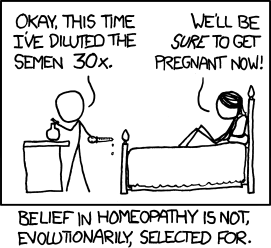 evidence is required before new or proposed treatments can be taken seriously. This means that comedy treatments like homoeopathy should be ignored and despised. No remedy should be considered as medicine unless is has been
shown through double blind trials to out-perform the placebo. Essentially, this is the basis upon which NICE make their decisions, though of course, they have the uncomfortable factor of cost, as well as efficacy to take into consideration.
Unfortunately, the world in general does not understand the evidence premise. Huge amounts of money are spent on “alternative” or “complementary” medicines. I quote these words deliberately, so that I can make it clear that complementary and alternative, have the same semantic meaning as snake-oil, bullshit and any other derogatory phrase you might want to insert.
If a private individual wants to go and get their overpriced placebo from the private sector, then good luck to them. However, I think it would be preferable for the company to make it clear in their documentation that the treatment is wholly ineffective. What really disgusts me is that some of these idiot treatments have been funded by the Tax Payer, via the NHS. This has been much reduced in recent months, but the pressure to provide bizarre quack solutions is still being pushed by the moronic utterances of our current Queen’s eldest son, who would be well advised to learn the value of silence, since he is clearly too stupid to learn the value of science.
Religious Evidence
I doubt if many religious people read this far. If you did, congratulations, thanks, and hopefully you have a sufficiently open mind to deal with what is to come. That said, if you still think your creed can be backed by “evidence” you have not understood any of the words above.
A few days ago, a small green card was pushed though my door. It read “Jesus loves me, this I know, for the bible tells me so”. This put me in mind of a fantastic illustration I saw recently about Mr Tickle.  Merely asserting facts is not providing evidence and religion is all about asserting facts. Various religions, and even different flavours of the same religion, assert mutually contradictory facts. They cannot both be correct. Only evidence could determine which, if either, is correct, but that is not the way that religious faith works. Advocates simply shout louder that their version of events is the only truth.
Political Evidence
The area where lack of respect for evidence most worries me is politics, public service and policy making. It’s a bit like the religious situation, where ideologies take the place reason and evidence, but it is even more dangerous. Politicians are seen as weak when they change their minds. This is ludicrous. Anyone who does not change their mind when presented with irrefutable evidence that they were wrong is insane. Remember the case of David Nutt, the government drugs advisor who had to be sacked for suggesting that drugs policy should be based on evidence, rather than ideology. This sparked real fury in the scientific community for a while, but nothing changed. We still have a stupid drugs policy that spends funds in a manner that is completely disproportionate to the real world harms caused. To do anything else would upset the Daily Mail and that would result in fewer votes at the next election.
So much public policy fails in this way. There is no evidence that academy schools are in any way beneficial, but the current government is pushing on with the expansion of these schools, because it fits their ideology.
We are to blame for this. Most people enter public service to be noticed and to feel important. They might think they are doing so for the furtherance of public good, but this is distinctly secondary to having a platform and lots of people listening to them. I generalise, of course, but the sort of person who craves such a platform is not the sort of person who calmly weighs evidence before deciding how to proceed. Introspection does not get you far in the cut-throat world of politics. Even before the rise of the professional politician, it was far more likely that a politician had a legal background (there’s a profession that has no idea about evidence) than a scientific background. At the next election please do try to take this into account as at least one factor when making your choice.
And yes, I am aware that Mrs Thatcher was a trained chemist, so maybe I should be careful of what I wish for.
 For now, let’s get back to my attempted
 You Know I'm Right
You must be logged in to post a comment.