Women’s Sport

Introduction

I have friends (and indeed a wife) for whom sport just seems like a silly notion – 22 blokes chasing an inflated bladder around a field – what’s all that about? But, for many of us, sport is a key part of our lives. It can be horrible- when my team loses I feel a real draining of energy and a sapping of morale. Over the years, I have been daft enough to follow some pretty unsuccessful sports teams, so that downer feeling is all too familiar. There is some chilling evidence linking sporting reverses with an increase in violence and domestic abuse. Sport is not always a power for good. So why is it so popular? I think there are several reasons:

Ben Stokes at the end of the best ever innings in Test Cricket.
  • The drama is more extreme than any fiction would ever dare to be. Yes there are plenty of tedious and predictable outcomes, but so too there are outcomes so remarkable that no Hollywood producer would ever sanction such a story line.
  • There is a primitive tribalism about supporting your team with a group of others. I almost used the word “like-minded”, but often we are not at all similar except for our shared passion. Chanting in a crowd is a thing of beauty, even if we are completely unreasonably questioning the parentage of the referee.
  • The highs of winning in sport, especially against the odds, are better than almost any other high I have experienced. I can’t really explain that, but it’s true. I think I would get less from supporting a perpetually successful team. The New Zealand All Blacks expect to win every rugby game they play, so there is only ever a down side for them. No team I have ever followed has been even remotely invincible, though some have been reasonably successful for a short period.

Anyway, that’s why sport is a big part of my life. I have been lucky enough to have taken part in various sports over the years, but never to any great level. I am realistically more of a spectator. For most of my life, the sport I have watched and cared about was played by men. There were some honourable exceptions in tennis, and especially athletics (think Sally Gunnel, Jessica Ennis, Kelly Holmes and others) but it is predominantly team sports that really matter to me and the profile of women’s team sports over the years has been feeble. Why is that?

Women’s sport has had a pretty chequered history. In many cases, the misogynistic governing bodies, almost always made up of wealthy, retired, elderly white blokes, have been downright hostile to the idea of women even being allowed to take part in their sport. In other cases, women’s sport has been treated with patronising disdain. A few sports provide an exception, though often grudgingly. Many of the things I have to say about women participating in sports could also be said of ethnic minorities, but for the purposes of this blog, I intend to dig a bit deeper into the role of women in sport.

History

Sport has presumably been a part of the Human condition from the very earliest times when homo sapiens came into existence and quite possibly for neanderthals before that. I guess there might have been events and displays to establish the alpha male hierarchy and all of that. However, organised sporting events are most easily traced back to the ancient Olympics in Greece, which are known to have taken place as early as 776 BC and continued every four years for the next 600 years or more.

Lunchbox

Those games were very male-centric, however. All of the competitors were male, but even worse, women were not allowed to even watch. Maybe that was because athletes traditionally competed naked. Imagine that with Linford Christie!

A caveat – I am not a sport historian and my big sister, who is, will probably be appalled by some of the over simplifications that follow.

Women were not allowed to compete even in the modern Olympics until 1920. Various bizarre reasons were cited, many of them pseudo-scientific, claiming that women, with their awkward reproductive systems and monthly cycles simply were not suited to athletic pursuits.

In the early 20th century, the mass exodus of young men to the world wars left huge gaps in western societies. Women’s suffrage is probably the most important advance to come from that period, but women also helped to fill the void of sport as a spectacle. In Britain, there were women’s football teams that attracted huge crowds. 53,000 seems to have been the most widely reported record in the early 1920s.

In the USA, there were similar tales, perhaps most notably chronicled by the 1990 film “A League of Their Own”, starring Geena Davis and Tom Hanks, which deals with a women’s baseball league during the latter half of WW2.

Hostility

Despite the popularity of women’s sport in the early 20th Century, the sporting authorities quickly mobilised to try to stamp it out. I’m sure there are many more examples of male hostility to women’s participation in sport, but I will highlight a few.

Football

It seems utterly incredible from the context of 2022, but the Football Association (FA) of England banned women’s football in 1921, stating that “the game of football is quite unsuitable for females and ought not to be encouraged.” Similar restrictions were imposed in other parts of the UK.

Many of you will have heard of Gail Emms. She is a fantastic athlete in her own right, having competed at Badminton in world championships and Olympics (gold and silver respectively). She is also a media figure and a regular contributor to radio shows like Fighting Talk on BBC Radio 5 Live. She was made an MBE in 2009. I’m no fan of the honours system, but this helps to build a picture of someone who has been successful in women’s sport.

What is not as widely known is that Gail’s mum, Jan, was an international footballer during the time of the FA ban. She was one of a team of women who ignored that ban and travelled to Mexico in 1971 for an unofficial women’s World Cup. Only six teams – Mexico, Argentina, England, Denmark, Italy and France took part. The England team had to do so without any backing from the FA and at their own expense. They lost both of their matches, but what an amazing set of rebels they must have been. The FA finally lifted the ban on women playing football on the back of this tournament, bringing to an end 50 years of misogynistic dictatorship. That does not mean they started to support women’s football – FIFA finally created an official tournament in 1991.

Athletics

In some respects, athletics (forgetting the restrictions of the early Olympians) has been more inclusive of women, but the record is far from clean. Some disciplines were considered too difficult for women. Even now, women have the heptathlon (7 events), while the male equivalent is the decathlon with 3 more events.

Much more jarring, however, is the history of the Marathon. One of the first women to challenge this assumption was Kathrine Switzer. She ran in the Boston Marathon in 1967, the organisers of which had just assumed that no women would dare to take part. The race director physically assaulted her when he realised that a women was competing in “his” race. I encourage you to follow the link above to see how that worked out for him.

Tennis

On the face of it, tennis is perhaps the sport where gender equality has been most readily adopted. There have been high profile women (or ladies as the tennis community would prefer) in the sport for longer than I can remember. I am just about old enough to remember Billie Jean King, but even before that there was Margaret Court and many others. Tennis it seems was the sport in which women could play and be taken seriously before almost any other. After Billie Jean King, there came the likes of Chris Evert, Martina Navratilova, Steffi Graf, Monica Seles, the Williams sisters, Venus and Serena and even a few British contributions with Sue Barker, Virginia Wade and most recently Emma Raducanu. This is far from an exhaustive list of women tennis players who have become household names.

I began this section with “on the face it”, and whilst there is no doubt that tennis has done better than most sports at encouraging gender equality, it has not always succeeded. Equal pay for both the men’s and women’s tours has long been a bone of contention. Back in Billie Jean’s day, the gap was at least ten-fold. It has closed since then, especially in the top tiers, with some of the majors offering equality.

There is a great article of pay differentials at adelphi.edu.

Tennis is not a favourite sport of mine, but I will continue with this because it is such an important example. Andy Murray is the most successful British tennis player for many decades. My Scottish friends point out that he is always Scottish when he loses and British when he wins. I’m Welsh, so amenable to such arguments, but that’s not the point here. Andy (and his brother Jamie, who is a highly successful player in his own right, especially in doubles) was coached by his mum Judy. Judy is clearly a very strong influence for Andy and Jamie. Andy has become famous for some particularly acerbic responses to interviewers that refer only to male tennis. Take a look at the following – honestly it will bring a smile to your face:

Cricket

My two favourite sports are Cricket and Rugby Union, so this is where | really get going. Women’s cricket was for years treated with disdain and contempt by a patronising misogynistic white middle class audience. The games lawmakers are the members of the Marylebone Cricket Club – the infamous MCC. They would not allow women to even join the club, excluding them from the pavilion at Lords.

Rachael Heyhoe Flint

The magnificent Rachael Heyhoe Flint (now a Baroness in a rather different Lords) was amongst the first 10 women to be admitted into the MCC in 1998. She was captain of England for more than 10 years and played for the national team for more than 20 years between 1960 and 1982. For many, even keen cricket followers like me, Rachael Heyhoe Flint was the only female cricketer we had heard of. She worked tirelessly and patiently to improve the profile of Women’s Cricket, often being subjected to degrading and insulting interviews. But, to some extent at least, it has worked.

Today the women’s game is in much better health. Several countries have a national team made up of full time professionals, with a professional league system backing up the national team. A big advance was made in 2021, with the introduction of the Hundred as a new format in Britain. I remain unconvinced of the need for a new format and I’m not sure the franchise system works in the men’s game, but there are some real advantages for the women’s game. The games are played in the same stadiums, back to back with the men’s games. Initially, you would see a small crowd at the start, gradually building as the start of the men’s game came closer, but as the tournament progressed attendances for the women’s game steadily climbed and it was obvious that many people were more invested in the women’s tournament. It was great to see mums and dads taking their daughters to watch the games and to see the daughters wearing the replica kits. That old adage of “You’ve go to see it to be it” surely means we have a generation of girls growing up to be the stars of the future.

Female cricketers are starting to become mainstream sports stars and amongst cricket fans, some have become household names. Retired cricketers, such as Isa Guha and Ebony Rainford-Brent (full name Ebony-Jewel Cora-Lee Camellia Rosamond Rainford-Brent) have been able to forge a successful career in the media as commentators and pundits for both the men’s and women’s games and have broken into the ultimate (though lovable) boys club – Test Match Special. The first woman I recall hearing on TMS was an attorney from Barbados called Donna Symmonds. She was brilliant and insightful, but the abuse she received for daring to commentate on men’s cricket is worth an article all of it’s own. Fortunately, there is one on Caribbean-Beat.

Rugby

Rugby has always been seen as a sport for tough, hairy alpha males and certainly in England (outside the south west, before my friends from Gloucester, Bristol and Bath start shouting at me) as the preserve of the public school educated. Against that backdrop, Women’s Rugby has struggled to gain the profile that we see in other sports, such as cricket and tennis.

There is now a professional system in England, but in supposedly rugby-mad Wales we are just starting to see a system emerge. In November 2021, the Welsh Rugby Union finally handed out 10 full time professional contracts. Ten! That’s not even a full team. TV coverage of the women’s game is sparse to say the least and there has been very little attempt to stage women’s matches at the same venue and day as the men’s matches. There have been a few attempts to do this in English club rugby, but more – much more – needs to be done.

In spite of this, women’s rugby still manages to produce some absolute superstars. I am going end this section with a bit of a celebration of one of them -Jasmine Joyce. If Jaz was doing what she is doing in the men’s game, she would be as the most famous person in Wales, but she has to play in England because of the lack of a professional setup in Wales. She has it all – pace to burn, determination, skill, elegance and brutality. She is lethal in attack, as shown in the following compilation.

But how about this for committed defence? I actually prefer this compilation.

Conclusions

I could go on forever – there are numerous sports I have not mentioned. Think of darts, where Farron Sherrock is now competing in what were thought to be men only tournaments. Think of boxing. I have previously spoken of my ambiguous and frankly inconsistent attitude to boxing. I will put my hand up and admit that I am too squeamish to watch women’s boxing, whilst my amygdala still seems to enjoy watching two men attempting to inflict brain damage on one another.

Anyway, I must bring this rambling to some sort of conclusion. Overall, I am optimistic about the future of women’s sport. Almost all sports seem to be going in the right direction, though some are much slower than others. I think (or is it hope) that there will be a virtuous circle that accelerates this process. The more women’s sport enjoys a higher profile, the more girls will see it and be encouraged to participate. Greater participation leads to still higher profile – onward and upward.

There are threats to that perhaps overly optimistic picture. The biggest threat is social media. We all know that social media is 90% toxic, but there are some trolls, keyboard warriors or morons – call them what you will – who seem intent on putting down women’s sport. Find any posting about women’s sport on Twitter and you will find a stream of dickheads commenting to the effect that they won’t be watching that. It’s bizarre – they must sit there in their squalid bedrooms all day searching for posts about women’s sport so that they can put it down. I hope and believe that this will be generational and that like all biases, this dislike of women competing in sport will fade into history, but I fear that will not happen fast. Those of us who love sport must fight for more coverage for women’s sport – it’s not enough to just passively enjoy it.
A Testing Day in Delhi

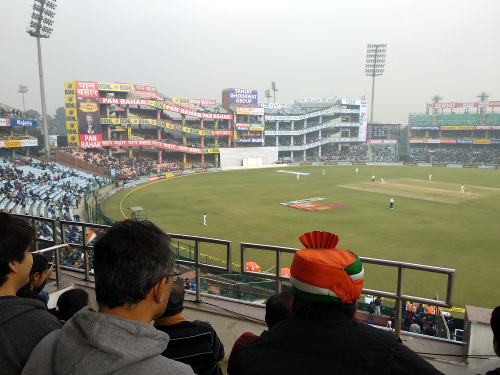
I have just had an incredible day. Pound for pound, I cannot remember a more experience packed day. I attended a day at a test match in Delhi, between India and Sri Lanka. That’s the headline, but it is worth describing the whole process in some detail…

Journey to the Stadium

I left my hotel at 0800, determined to travel to the stadium as a local would. I asked the concierge for directions to the nearest Metro Station – the beautifully named Iffco Chowk. They immediately tried to order a car for me, but I insisted that I wanted to walk. They looked at me as though I were a complete weirdo (perhaps I am), but eventually conceded that walking was possible. There’s a lot of construction going on around the hotel and the roads were pretty dusty and dilapidated, but perfectly walkable. It was only a mile or so to the station, but this still took me past five or six casual games of cricket, played, quite literally, in dust bowls. No wonder this country specialises in spinners. This is clearly how loads of the locals spend their Sunday mornings. As well as cricket matches, I also encountered a surprising number of feral dogs. Sadly, they are so starved that they have not got the energy to be threatening, but they do present a sorry spectacle.

At the metro station, I was puzzled as to how to pay for my journey. I had read about buying a smart card, similar to the Oyster Card used in London, so I got into a queue at the ticket office. At least, I thought I’d got into the queue, but the fact that I’d left a gap of about 9 inches between myself and the person in front of me was a clear signal to one local that I was not at all serious about this whole queuing business and he squeezed into that gap. When I finally got to the front of the queue, the ticket seller looked at me as though I was a complete halfwit and pointed me to another queue where they dealt with smart cards. I transferred to the new queue, taking care to press myself against the body of the person in front. Sadly, this did not stop me from being out-flanked by one determined queue jumper, but I eventually got to the front of this queue, too. I handed over a surprisingly small amount of cash, got my card and I was away

Happily, I’d had the foresight to install a Delhi Metro app on my phone, which by now was receiving data from the cheap sim I’d bought at the airport and, impressively, I got on the right train first time. I had a relatively unremarkable journey – the train was uncrowded, so I got a seat. However, one small tale is worth relating. A young lady plugged her phone charger into the socket above my seat. Not long after, the train took a bit of a lurch and momentarily caught said young lady off balance. She stumbled backward, pulling the charger out of the socket, whereupon it landed directly on my head creating a loud “donk” sound, clearly heard by all in the coach. My thick skill was unharmed, but the girl was both mortified and humoured. She tried desperately to apologise profusely, through increasingly hysterical giggles and in the end simply fled to another part of the train, deciding that she did not need to charge her phone that much.

One change later and I arrived at the Feroz Shah Kot;la stadium. Loads of rickshaws competed for my attention, but I studiously ignored them and walked the 250m to the stadium entrance.

Getting into the Stadium

At the stadium, I was greeted by a surprisingly large number of heavily armed soldiers most of whom wanted to check my bag. I was more than happy to comply with their wishes, partly because I had nothing more dangerous in my bag than a cap, sun glasses and a jacket, but mostly because I make a habit of obeying heavily armed soldiers. All told, my backpack was checked manually and x-rayed four times before I finally got to the turnstile.

At the turnstile, I presented the printout of the ticket that had been ordered online by a friend. The actual ticket had not arrived in time, but the printout had a QR code and looked official. The people at the gate looked a bit confused and called for a supervisor, who came over and also looked confused. Eventually, he pointed his scanner at the QR code, beamed with pleasure when it scanned successfully and he let me in.

box
View from my Box

Once into the ground, I quickly found the stairs that took me to the hospitality box that had been booked for me. This was a medium sized room, with a window looking out over the oval. There was a fridge, with complimentary soft drinks and an array of snacks (or “bitings” as the Indians call them). In front of this were 40 or so seats, mostly already occupied where we could sit and watch the cricket. I grabbed a coke (I was not yet 10am) and headed out to get a seat.

The Match

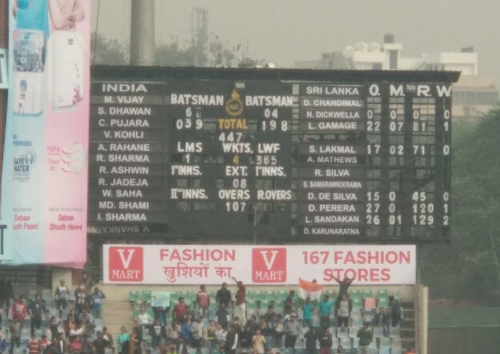
This was day 2 of the test, and as I sat down, Virat Kohli, the current captain of India and one of the very best batsmen ever to play the game was on 178. He quickly and elegantly moved into the 190s. The tension was considerable. A score of 200 would make him the scorer of the most double centuries by any captain in the history of test cricket. As is often the case, his scoring slowed, but he eventually passed 200 and the response of the crowd was electric.

score
Kohli on 198

I confess that I have long harboured mixed feelings about Indian cricket fans. They obviously love the game, but test matches are often poorly attended, whilst shorter forms of the game attract the really huge crowds. The capacity of the Feroz Shah Kotla ground in Delhi is just shy of 50,000. It was not full on this particular occasion, but I bet there were more that 30,000 in attendance. By comparison, Lords in North London, the so-called home of cricket holds just 28,000. Moreover, the cricketing knowledge of many of the people in the same area as me was considerable. They were obviously a bit surprised to find a white bloke (gora in the vernacular) in their midst, but politely tried not to notice too much. I think I was one of only 4 white people in the ground. The other three were Nigel Llong – one of the umpires, David Boon – the match referee and the Sri Lankan Coach, Nic Pothas. However, I gave up my seat at one point so that an old couple could sit together and at this point my neighbours seemed to think I was alright. I got chatting to a few of them about cricket – not just the match in front of us, but also the Ashes games being played in Adelaide at the same time. They were full of commiserations for England’s woes. I was made to feel very welcome and encouraged to eat as much of the complimentary food as I could hold. All this before lunch.

Lunch

At a cricket match in Britain, lunch is usually taken between 13:00 and 13:40. Here in India, matches have to start much earlier, due to the shorter days, so lunch is taken at 11:30. I was not the least bit hungry, having stuffed myself with Samosas, pakora and other bitings, but I was starting to think that a beer could be justified. I went off in search of a bar. It did not take long to realise that unlike in English grounds, where you can walk around the entire stadium sampling numerous bars, here I was confined to a very small segment of the stadium and this segment did not feature a bar. It turns out that cricket in India is essentially a non-alcoholic experience. I can only assume that this is changed when the Barmy Army are in town – who would turn down that commercial possibility, but it rather turned my world on end. I’ve never spent a sober day at a cricket match before. Back to the box, then.

Air Pollution

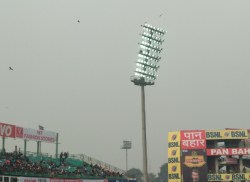
lights.jpg
Vultures circling the lights at midday.

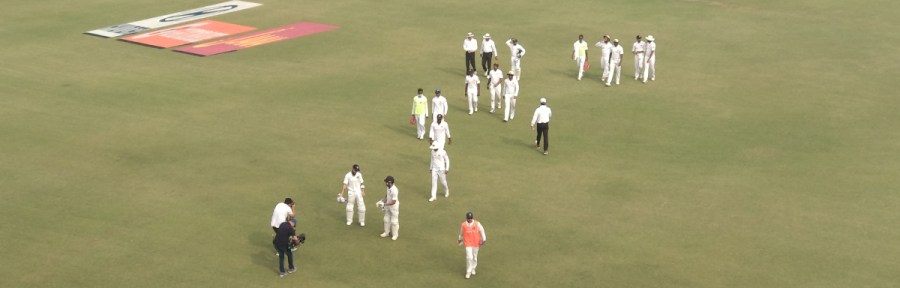
With the locals cheerfully counting down each run required for Kohli to get his triple century, he rather unexpectedly got out for 243. This was greeted with stunned silence, apart from the enthusiastic guy sat next to me who eloquently muttered “Oh Shit!”. Thereafter, the game dragged on a bit with India pushing for a big total, but the Sri Lankan fielders had taken to wearing pollution masks. The air pollution in Delhi at the moment is a real problem, with the air quality index being rated somewhere between “unhealthy” and “hazardous”. You don’t really get to see the sky, as there is a thick pall of brown smog hanging over the city. Indeed, at 13:00 on an ostensibly cloudless day, the floodlights were turned on, due to the poor light.

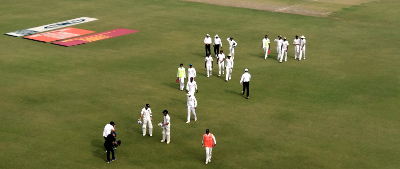
The lights, however, did not help the Sri Lankans. Their fast bowlers, in particular were having to leave the field more and more and eventually they were unable to field 11 fit players. How much of this was for real or how much was an attempt to manipulate the situation in a match they were losing, I cannot say. However, the locals were incensed and started loudly calling the Sri Lankan manhoods into  question. It was like they know the pollution in their city is terrible, but they don’t want foreigners drawing attention to it. The Sri Lankans got to the point where it seemed they could/would not play on, so Kohli dealt with the situation by declaring. His body language seemed to imply that the Indians were man enough to bowl in a bit of smog, even if the Sri Lankans were not.

masks
The Sri Lankans Leaving the Field


This did at least give me a chance to watch some Indian bowling and they quickly got a few wickets, to the delight of the crowd.

Getting Home

spitting

I left a few minutes before close of play, fearing a crowded metro. Unfortunately, so did 15,000 other people. It truly was as crowded as the worst London rush hour on the Northern Line that I have experienced., but there was no hassle or unpleasantness. I was grateful, however, for the occasional announcements reminding people not to spit inside the train. Coupled with the signs in the stations forbidding spitting, I have to conclude that the metro is no place for an enthusiastic spitter.

Not yet feeling that I’d had enough experiences for the day, I got off one stop early in a busy shopping district. I wandered in the mall, after the obligatory x-ray of my bag, but there’s not much of interest in an Indian shopping mall, that you would not find in a mall in the US or Britain.

It was now full dark outside, so I decided that it would be too intrepid to walk home, so instead I set about engaging a rickshaw. These come in various shapes and sizes, but most are converted motorcycles with a green and yellow canopy on the back. However, a young lad with a bicycle rickshaw caught my eye and he quickly closed the deal. 50 rupees to take me to my hotel, a mile or so down the road. I’m no lightweight, so he was always going to have to earn his corn, but I don’t think he realised that you could not get into the hotel the most obvious way, but instead had to cross a dual carriage way, travel a mile past the hotel, turn around and come a mile back. This he did without complaint, apparent fear or lights, with cars screaming past us on both sides with horns blaring.

I got there in one piece, felt that 50 rupees did not sufficiently represent my pleasure at having survived, so overpaid generously. We all went away happy.

What a day!

Test Match Innovations

It appears that the cricket authorities are finally waking up to the fact that Test Match Cricket is not in an entirely healthy state across the globe. The growth in the popularity of the short forms of the games has resulted in very low crowds for test cricket in some parts of the world. As someone who thinks that test cricket is the only important international form of the game, this is desperately bad news, but it has been building for quite some time. Personally, I am bemused by this. I am constantly told by commentators that the cricket fans in India are really knowledgeable, but all of the evidence suggests otherwise – they can only fill a stadium if the players are wearing pyjamas.

The only countries that clearly give a shit about test cricket are England, Australia and South Africa. It’s hard to be sure about Pakistan and the West Indies, but I am prepared to give the benefit of the doubt in both cases. Pakistan have been obliged to play outside their own country for so long that it is impossible to gauge the immediate popularity of test cricket at home. However, I find it hard to believe that a test match against almost any opposition in Lahore would fail to draw a full house. And, whilst the way that Pakistan play cricket does work in the short form, it works better in the longer form. Most all of the truly great Pakistan cricketers have been bowlers and test cricket is the only form where bowlers can be the stars.

West Indies is a harder case to argue. 20 years ago, WI fans were great value and test cricket was clearly what they cared about. More recently,when England tour, we buy a lot of tickets, especially at Barbados and completely skew the statistics. However, the pitches prepared for recent tours suggest that the authorities are more interested in 5 days of drunken tourist excess than a good cricket match. When other countries tour, the stadiums are empty.

Day Night Tests

in the last few years there has been  a big push for Day Night tests. The big blocker was the ball. Recent trials between Australia and New Zealand with a pink lacquered ball seem to have gone reasonably well. Fair enough. In parts of the world where dew is not an issue this seems like a reasonable idea. But, let’s  be clear on why the desire for day-night matches exists. It is because people are not prepared to give up a day of their annual leave in order to attend a day at the test match.

In some parts of the world this might work and I do not oppose the concept. In Britain, however, I think the idea is crap. We have dew issues throughout almost the whole of the year and this really would compromise the fairness of matches. Furthermore, in  Britain the suggestion is to resolve a problem that does not exist. Test matches are very well attended, thank you very much.

Joint Series

The latest bullshit idea to come from the ECB (you really would think Andrew Strauss would know better) is this idea of scoring across multiple formats to make up a series. What is worse, a test match is worth only twice the value of an ODI or T20 match. This means that in the current Sri Lanka tour of England, 12 points  are available for the 3 test matches, 10 points for the 5 ODIs and 2 points for the single T20. Bah! CricInfo even has a points table – what a nonsense.

A test series is a test series. You can combine the ODIs andT20s all you like – I don’t give a damn. But, combining test results with comedy cricket – that can’t be right. This was introduced for women’s cricket, where the semi-professional nature of the game means that only one test is possible. This is not the case in the men’s game. A test series should consist of at least 3 matches and it should stand on its own merits. The proliferation of 2 match series is not good news, but this summer at least, we do not have this problem.

If this is an attempt to make test cricket more “relevant”, then it is misguided. If, as seems more likely, it is an attempt to make people who care about test cricket care a bit more about pyjama cricket, then it is cretinous. Do not try to force me to care about the rubbish product by devaluing the real product. How dare you? Strauss – you should be ashamed.


Fast Bowling

With the retirement if Mitchell Johnson, the game of cricket has lost another one of its truly fast bowlers.

You can wax lyrical all you like about the metronomic precision of McGrath, the craft of Anderson, the guile of Warne, or the shear weirdness of Murali. But, for true drama and excitement, you need a fast bowler on a decent pitch tearing in off his long run with the full umbrella cordon and the courageous batsman doing everything he can to survive, both literally and figuratively. Think Holding against Boycott; Donald against Atherton. Hostile, brutal, breath-taking stuff.

He bowls to the left.
He bowls to the right.
That Mitchell Johnson,
His bowling is shite!

Johnson was perhaps more mercurial than most of the greats of the game. I saw him at Cardiff in the first Ashes test of 2009. He took a few wickets, but he was all over the place and failed to break the final wicket stand between Panesar and Anderson. The crowd cheerfully chanted the Mitchell Johnson song to the tune of that Stealer’s Wheel number. Four years later, though he was devastating. He had found a way to make that seemingly fragile, slingy action repeatable and was, for a while, the best bowler in the world.

I’ve been lucky enough to see quite a few of the great fast bowlers in action, but I do worry about them being eliminated from the game. There are several reasons for this.

  • There is less of an obvious role for an out-and-out quick in coloured clothing cricket. They cannot be guaranteed to be economical. The really thrilling attacking fields have no place in a game where runs, not wickets matter. Stupid, batsman-favouring rules prevent the use of proper short balls as a weapon.
  • Modern pitches are becoming dull and lifeless. Reme101303_78a2ad6c9cf985841ce43d86d6af5361mber Sabina Park in the 80s. You could see your reflection on it. Pitches in the West Indies are now more like a long jumper’s sandpit. No wonder they don’t produce great bowlers any more. Who would want to bowl quickly on a beach?
  • India is having a huge influence on the game of cricket. They are the economic powerhouse of the modern game and they care only for batsmen. Who are the great heroes of India? Sachin, Laxman, Dravid, Dhoni, Gavaskar. Kumble and Bedi might get a look in if not for the obsession with the short form of the game but a pace bowler… Kapil? Great player, but hardly a hell-raiser.
  • Domestic cricket no longer attracts the pace bowler as it once did. And, when a great player does come to play county cricket, it’s no longer even for a whole season. Players used to be associated with Counties in England for much of their career. Wasim at Lancashire, Marshall at Hampshire, Walsh at Gloucestershire, Donald at Warwickshire. Fans took these players to their hearts and County cricket mattered, because you were watching world class performers. The reduction in overseas pros to just one per county put a greater emphasis on batsmen and all-rounders – they were more use in the lucrative one day games.

Enlarging on this last point for a while, by way of self-indulgence, the fastest bowling I have ever seen in the flesh was by a young Allan Donald. As a student in Birmingham, I saw a lot of Warwickshire in the late 80s. South Africa was still in the wilderness and we fondly hoped that England would be able to persuade Donald to play for them. No such luck. I have misty memories of sitting side-on at Edgbaston for one of Donald’s spells. I think it was against Lancashire. Little Keith Piper was standing miles back, with the slips even deeper. It’s the quickest spell I’ve ever seen and I did see Shoaib in his pomp and he was not slow.

On the international scene, I missed the very best of the West Indies quicks by a few years. I saw lots of Ambrose and Walsh live, but never saw Holding, Marshall, Roberts or Garner. I did see Wasim and Waqar bowling in tandem and I don’t think I have ever seen a better pair working together. They were devastating. I missed Lilley and Thompson, but I did see lots of Brett Lee, Shaun Tait and the Mitchells.

So, what can be done to get more fast bowlers onto the scene? As with spin bowlers, English conditions do not favour the real pace men. Seam and swing bowling dominate. We have never had the conveyor belt of great quicks like the West Indies, Pakistan, South Africa and Australia. This need not be the case – many of the examples above really prospered in England, but the relentless treadmill of English cricket takes its toll. Allow more overseas players? I would. We do not need a long procession of mediocre English and Kolpak players. Let’s get the world class players back into the game.

And on the global scene, we must reverse the decline of Test Match cricket. Alright, I’m going to nail my colours (perhaps that should be whites) to the mast and call a spade a spade. First Class Cricket is real cricket. The rest with white balls and coloured clothing is for the kids. It’s a pretty spectacle, but it’s not the real game – like comparing Chateaunuf du Pape with Ribena. How do we reverse this decline? I wish I knew, but all of the following would help:

  • Improve the over rate. Really. Don’t just talk about it. Actually do it. Harsh in-game penalties for slow over rates would do it, along with long bans for regular or cynical transgressions.
  • Get rid of bad light.
  • All series should be a minimum of 3 matches.
  • A meaningful world championship well financed.
  • Some coverage on free-to-air TV.

There you go. Piece of piss!

Cricket Own-Goals

In spite of the dull, lifeless pitches – the inevitable result of playing cricket in a desert – upon which the recent Pakistan v England test series was played, the cricket was at times compelling. But,  two things marred this series (and many other series for that matter) for me: the toss and bad light. What is most frustrating is there is a simple answer in both cases – get rid of it. Let’s take these one at a time.

The Toss

The idea of having a toss at the start of a match to decide who bats first seems fair enough, but all too often the toss is the single most important factor in deciding the outcome of the match, especially if the two teams are pretty evenly matched. In the Pakistan series, the “home” team won the toss in all three matches. Unlike in some conditions, where winning the toss gives a captain a tricky decision, winning the toss in the UAE, or most of Asia for that matter gives a significant advantage. Bat first and watch the pitch break up until it really starts to take turn on the last day when you should be bowling.
The home team, however, already has a big advantage – they are playing in conditions to which they are accustomed. So, why not even this up by allowing the away team the choice of who bats first. This does away with the element of chance and maximises the likelihood of a close contest, which must be what we all want.

Bad Light

Another frequent bane of test matches is bad light. Teams (all teams) get through their overs at a ludicrously slow rate. I’m not going to get onto that particular rant now, but it is safe to say that one of the results of it is that play goes beyond the scheduled hours of play almost every day of every test match. These days, the maximum by which a day can be extended is 30 minutes, but even so, matches are scheduled at times when it is clearly not possible to complete that extra 30 minutes without the light becoming to poor for play, so the public is robbed of cricket for which they have paid and occasionally, an otherwise tense, exciting finish is replaced by the depressing, anti-climactic spectacle of the light meters coming out and the plays walking off.

We saw exactly that in the 1st test in Dubai. After four days a tedium, an electric finish was set up by some fine English bowling coupled with suicidal Pakistani batting. England required 99 to win off 19 overs – a target that should have been straight forward. But, the light was fading and Pakistan contrived to bowl their overs at a rate that would have been embarrassingly shameful, were it not for the fact that every team in world cricket would have done exactly the same. The problem was not the players, but weak umpiring. The umpires just stood by and watched the time wasting antics and then, at the expected time, out came the light meters and off they all walked.

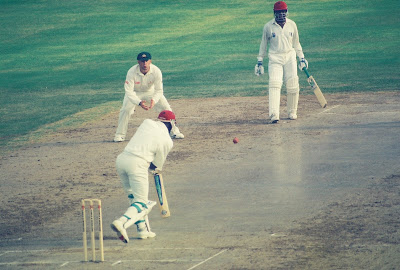
Graeme Thorpe and Nasser Hussain winning the 3rd Test at Karachi in 2000, in near darkness.

Back in 2000 at Karachi, a strikingly similar situation was overcome by the excellent umpiring of Steve Bucknor who kept play going on into much worse gloom on the basis that Pakistan could and should have got the overs in in perfectly good light. 15 years on and the new generation of umpires, completely emasculated by the ICC had no such backbone.

It seems safe to assume that the ICC will never provide their umpires with powers and sanctions to actually force a sensible over rate. If they were ever going to do this, surely they would have done so by now. Fortunately, the bad light problem is even easier to solve than the toss. Get rid of it. Remove it from the laws of the game entirely. At the start of a match, everyone know what the hours of play will be and that they can be extended by up to 30 minutes (there are further provisions for the last hour or the last day, but the details are not critical to the general argument). Play should then take place at that time. Play is not abandoned if it’s a bit windy, or hot, or humid. Dim light should be seen as a similar phenomenon. If the hours of play (and sadly, that is a big if) are chosen sensibly very poor conditions should not be experienced, especially as most test grounds now have lights. And, the argument for player safety is simply does not hold any water.

Outside of Britain, audiences for test cricket (the only real form of cricket for those of us who really care about the game) have dwindled alarmingly. But, test cricket can be intriguing, fascinating, compelling and exciting if only it is given a chance. Come on ICC – over to you.