
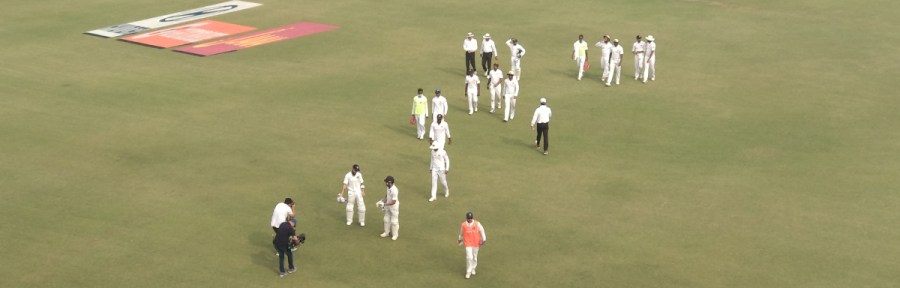
I have just had an incredible day. Pound for pound, I cannot remember a more experience packed day. I attended a day at a test match in Delhi, between India and Sri Lanka. That’s the headline, but it is worth describing the whole process in some detail…
Journey to the Stadium
I left my hotel at 0800, determined to travel to the stadium as a local would. I asked the concierge for directions to the nearest Metro Station – the beautifully named Iffco Chowk. They immediately tried to order a car for me, but I insisted that I wanted to walk. They looked at me as though I were a complete weirdo (perhaps I am), but eventually conceded that walking was possible. There’s a lot of construction going on around the hotel and the roads were pretty dusty and dilapidated, but perfectly walkable. It was only a mile or so to the station, but this still took me past five or six casual games of cricket, played, quite literally, in dust bowls. No wonder this country specialises in spinners. This is clearly how loads of the locals spend their Sunday mornings. As well as cricket matches, I also encountered a surprising number of feral dogs. Sadly, they are so starved that they have not got the energy to be threatening, but they do present a sorry spectacle.
At the metro station, I was puzzled as to how to pay for my journey. I had read about buying a smart card, similar to the Oyster Card used in London, so I got into a queue at the ticket office. At least, I thought I’d got into the queue, but the fact that I’d left a gap of about 9 inches between myself and the person in front of me was a clear signal to one local that I was not at all serious about this whole queuing business and he squeezed into that gap. When I finally got to the front of the queue, the ticket seller looked at me as though I was a complete halfwit and pointed me to another queue where they dealt with smart cards. I transferred to the new queue, taking care to press myself against the body of the person in front. Sadly, this did not stop me from being out-flanked by one determined queue jumper, but I eventually got to the front of this queue, too. I handed over a surprisingly small amount of cash, got my card and I was away
Happily, I’d had the foresight to install a Delhi Metro app on my phone, which by now was receiving data from the cheap sim I’d bought at the airport and, impressively, I got on the right train first time. I had a relatively unremarkable journey – the train was uncrowded, so I got a seat. However, one small tale is worth relating. A young lady plugged her phone charger into the socket above my seat. Not long after, the train took a bit of a lurch and momentarily caught said young lady off balance. She stumbled backward, pulling the charger out of the socket, whereupon it landed directly on my head creating a loud “donk” sound, clearly heard by all in the coach. My thick skill was unharmed, but the girl was both mortified and humoured. She tried desperately to apologise profusely, through increasingly hysterical giggles and in the end simply fled to another part of the train, deciding that she did not need to charge her phone that much.
One change later and I arrived at the Feroz Shah Kot;la stadium. Loads of rickshaws competed for my attention, but I studiously ignored them and walked the 250m to the stadium entrance.
Getting into the Stadium
At the stadium, I was greeted by a surprisingly large number of heavily armed soldiers most of whom wanted to check my bag. I was more than happy to comply with their wishes, partly because I had nothing more dangerous in my bag than a cap, sun glasses and a jacket, but mostly because I make a habit of obeying heavily armed soldiers. All told, my backpack was checked manually and x-rayed four times before I finally got to the turnstile.
At the turnstile, I presented the printout of the ticket that had been ordered online by a friend. The actual ticket had not arrived in time, but the printout had a QR code and looked official. The people at the gate looked a bit confused and called for a supervisor, who came over and also looked confused. Eventually, he pointed his scanner at the QR code, beamed with pleasure when it scanned successfully and he let me in.
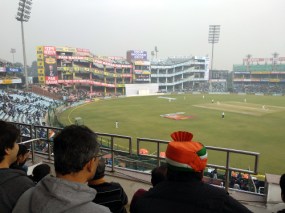
Once into the ground, I quickly found the stairs that took me to the hospitality box that had been booked for me. This was a medium sized room, with a window looking out over the oval. There was a fridge, with complimentary soft drinks and an array of snacks (or “bitings” as the Indians call them). In front of this were 40 or so seats, mostly already occupied where we could sit and watch the cricket. I grabbed a coke (I was not yet 10am) and headed out to get a seat.
The Match
This was day 2 of the test, and as I sat down, Virat Kohli, the current captain of India and one of the very best batsmen ever to play the game was on 178. He quickly and elegantly moved into the 190s. The tension was considerable. A score of 200 would make him the scorer of the most double centuries by any captain in the history of test cricket. As is often the case, his scoring slowed, but he eventually passed 200 and the response of the crowd was electric.
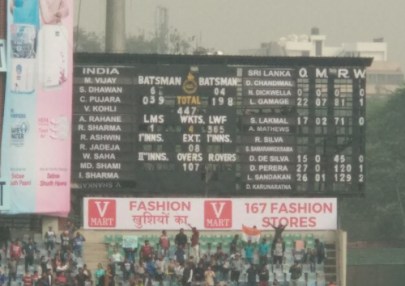
- Kohli on 198
I confess that I have long harboured mixed feelings about Indian cricket fans. They obviously love the game, but test matches are often poorly attended, whilst shorter forms of the game attract the really huge crowds. The capacity of the Feroz Shah Kotla ground in Delhi is just shy of 50,000. It was not full on this particular occasion, but I bet there were more that 30,000 in attendance. By comparison, Lords in North London, the so-called home of cricket holds just 28,000. Moreover, the cricketing knowledge of many of the people in the same area as me was considerable. They were obviously a bit surprised to find a white bloke (gora in the vernacular) in their midst, but politely tried not to notice too much. I think I was one of only 4 white people in the ground. The other three were Nigel Llong – one of the umpires, David Boon – the match referee and the Sri Lankan Coach, Nic Pothas. However, I gave up my seat at one point so that an old couple could sit together and at this point my neighbours seemed to think I was alright. I got chatting to a few of them about cricket – not just the match in front of us, but also the Ashes games being played in Adelaide at the same time. They were full of commiserations for England’s woes. I was made to feel very welcome and encouraged to eat as much of the complimentary food as I could hold. All this before lunch.
Lunch
At a cricket match in Britain, lunch is usually taken between 13:00 and 13:40. Here in India, matches have to start much earlier, due to the shorter days, so lunch is taken at 11:30. I was not the least bit hungry, having stuffed myself with Samosas, pakora and other bitings, but I was starting to think that a beer could be justified. I went off in search of a bar. It did not take long to realise that unlike in English grounds, where you can walk around the entire stadium sampling numerous bars, here I was confined to a very small segment of the stadium and this segment did not feature a bar. It turns out that cricket in India is essentially a non-alcoholic experience. I can only assume that this is changed when the Barmy Army are in town – who would turn down that commercial possibility, but it rather turned my world on end. I’ve never spent a sober day at a cricket match before. Back to the box, then.
Air Pollution
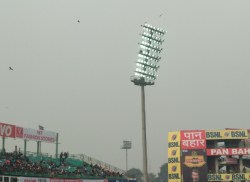
With the locals cheerfully counting down each run required for Kohli to get his triple century, he rather unexpectedly got out for 243. This was greeted with stunned silence, apart from the enthusiastic guy sat next to me who eloquently muttered “Oh Shit!”. Thereafter, the game dragged on a bit with India pushing for a big total, but the Sri Lankan fielders had taken to wearing pollution masks. The air pollution in Delhi at the moment is a real problem, with the air quality index being rated somewhere between “unhealthy” and “hazardous”. You don’t really get to see the sky, as there is a thick pall of brown smog hanging over the city. Indeed, at 13:00 on an ostensibly cloudless day, the floodlights were turned on, due to the poor light.
The lights, however, did not help the Sri Lankans. Their fast bowlers, in particular were having to leave the field more and more and eventually they were unable to field 11 fit players. How much of this was for real or how much was an attempt to manipulate the situation in a match they were losing, I cannot say. However, the locals were incensed and started loudly calling the Sri Lankan manhoods into question. It was like they know the pollution in their city is terrible, but they don’t want foreigners drawing attention to it. The Sri Lankans got to the point where it seemed they could/would not play on, so Kohli dealt with the situation by declaring. His body language seemed to imply that the Indians were man enough to bowl in a bit of smog, even if the Sri Lankans were not.
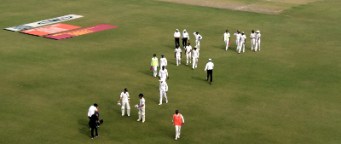
This did at least give me a chance to watch some Indian bowling and they quickly got a few wickets, to the delight of the crowd.
Getting Home
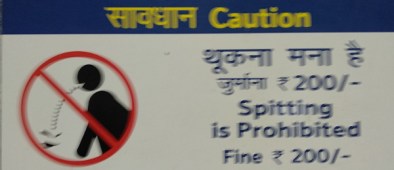
I left a few minutes before close of play, fearing a crowded metro. Unfortunately, so did 15,000 other people. It truly was as crowded as the worst London rush hour on the Northern Line that I have experienced., but there was no hassle or unpleasantness. I was grateful, however, for the occasional announcements reminding people not to spit inside the train. Coupled with the signs in the stations forbidding spitting, I have to conclude that the metro is no place for an enthusiastic spitter.
Not yet feeling that I’d had enough experiences for the day, I got off one stop early in a busy shopping district. I wandered in the mall, after the obligatory x-ray of my bag, but there’s not much of interest in an Indian shopping mall, that you would not find in a mall in the US or Britain.
It was now full dark outside, so I decided that it would be too intrepid to walk home, so instead I set about engaging a rickshaw. These come in various shapes and sizes, but most are converted motorcycles with a green and yellow canopy on the back. However, a young lad with a bicycle rickshaw caught my eye and he quickly closed the deal. 50 rupees to take me to my hotel, a mile or so down the road. I’m no lightweight, so he was always going to have to earn his corn, but I don’t think he realised that you could not get into the hotel the most obvious way, but instead had to cross a dual carriage way, travel a mile past the hotel, turn around and come a mile back. This he did without complaint, apparent fear or lights, with cars screaming past us on both sides with horns blaring.
I got there in one piece, felt that 50 rupees did not sufficiently represent my pleasure at having survived, so overpaid generously. We all went away happy.
What a day!
 You Know I'm Right
You must be logged in to post a comment.